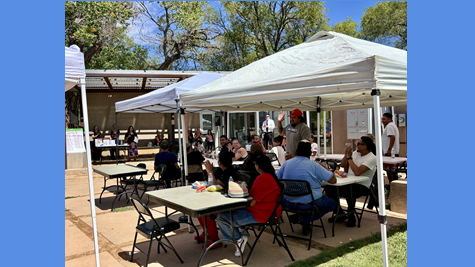
The Metropolitan Court’s Urban Native American Healing to Wellness Court hosted its annual Fall Feast at the Bachechi Open Space the afternoon of September 10th.
The Feast began with a traditional prayer, and program participants and their families enjoyed a meal prepared by the Specialty Court Team.
Those in attendance had the honor of hearing from Allen B. King (Zuni Pueblo/Diné), a Tribal Liaison, consultant, national keynote speaker, and cultural educator with over a decade of experience in behavioral health, recovery, and community empowerment.
A survivor and advocate, Allen shared his personal journey of resilience to inspire others, weaving together culture, storytelling, and lived experience. Allen has presented at national conferences, wellness courts, and community gatherings across the country, focusing on recovery, suicide prevention, cultural identity, and trauma-informed care. Cultural entertainment was also provided by a current program participant and behavioral health providers.
“Our Fall Feast is a time of reflection and renewal. For our participants, it is both a cultural celebration and a recognition of the strength it takes to walk the path of recovery. It reminds us that healing is not done in isolation, but with the support of community, tradition, and accountability,” said Judge Renée Torres, who has presided over the Urban Native American Healing to Wellness Court for eight years now.
The Urban Native American Healing to Wellness Court takes a holistic approach to recovery, while also focusing on individual case management for self-identified Native Americans with two or more DWI convictions. The intensive year-long program follows the national model for treatment courts while also using a cultural values reinforcement approach to meet the needs of its participants, who are from numerous tribes. Participants engage in groups such as Food As Medicine, Women’s and Men’s Wellness Groups, Cultural Enrichment, Healing Arts, Horse Medicine, Nature Fitness, Talking Circles and other sessions designed to strengthen participants’ cultural values.
Twenty-eight participants graduated from the Specialty Court program last fiscal year.
By clicking 'Continue' you will be redirected to

